Father, author, developer, maker. Please consider sponsoring my work.
My own magic-wormhole relay, for zippier transfers
If you've ever had to transfer a file from one computer to another over the Internet, with minimal fuss, there are a few options. You could use scp or rsync if you have SSH access. You could use Firefox Send, or Dropbox, or iCloud Drive, or Google Drive, and upload from one computer, and download on the other.
But what if you just want to zap a file from point A to point B? Or what if—like me—you want to see how fast you can get an individual file from one place to another over the public Internet?
…Soundproofing my studio: what's in a wall?

Soundproofing is... kind of an art. It's not as simple as buying something and slapping on your walls. And the word 'soundproofing' is a bit of a loaded term.
You could mean deadening sound, so you can record podcasts with that signature radio sound. Or you could mean isolating a room from outside noise, which is an entirely different process. Or you could work on reducing resonance, echo, or just certain frequencies.
…Testing iperf through an SSH tunnel
I recently had a server with some bandwidth limitations (tested using scp and rsync -P), where I was wondering if the problem was the data being transferred, or the server's link speed.
The simplest way to debug and verify TCP performance is to install iperf3 and run an iperf speed test between the server and my computer.
On the server, you run iperf3 -s, and on my computer, iperf3 -c [server ip].
Fork Yeah! Examining open source history after Red Hat's move
We're at the stage in the Red Hat drama where everyone is consulting history, trying to figure out what parts are being repeated in 2023 after Red Hat effectively locked down the sources used to build RHEL clones.
One talk linked quite often was Fork Yeah! The Rise and Development of illumos, by Bryan Cantrill over a decade ago. Bryan was a software engineer at Sun, who went over to Oracle after the buyout, then left to join Joyent, and now resides as CTO of Oxide.
…Time Card mini adds Pi, GPS, and OCXO to your PC
For LTX 2023, I built this:
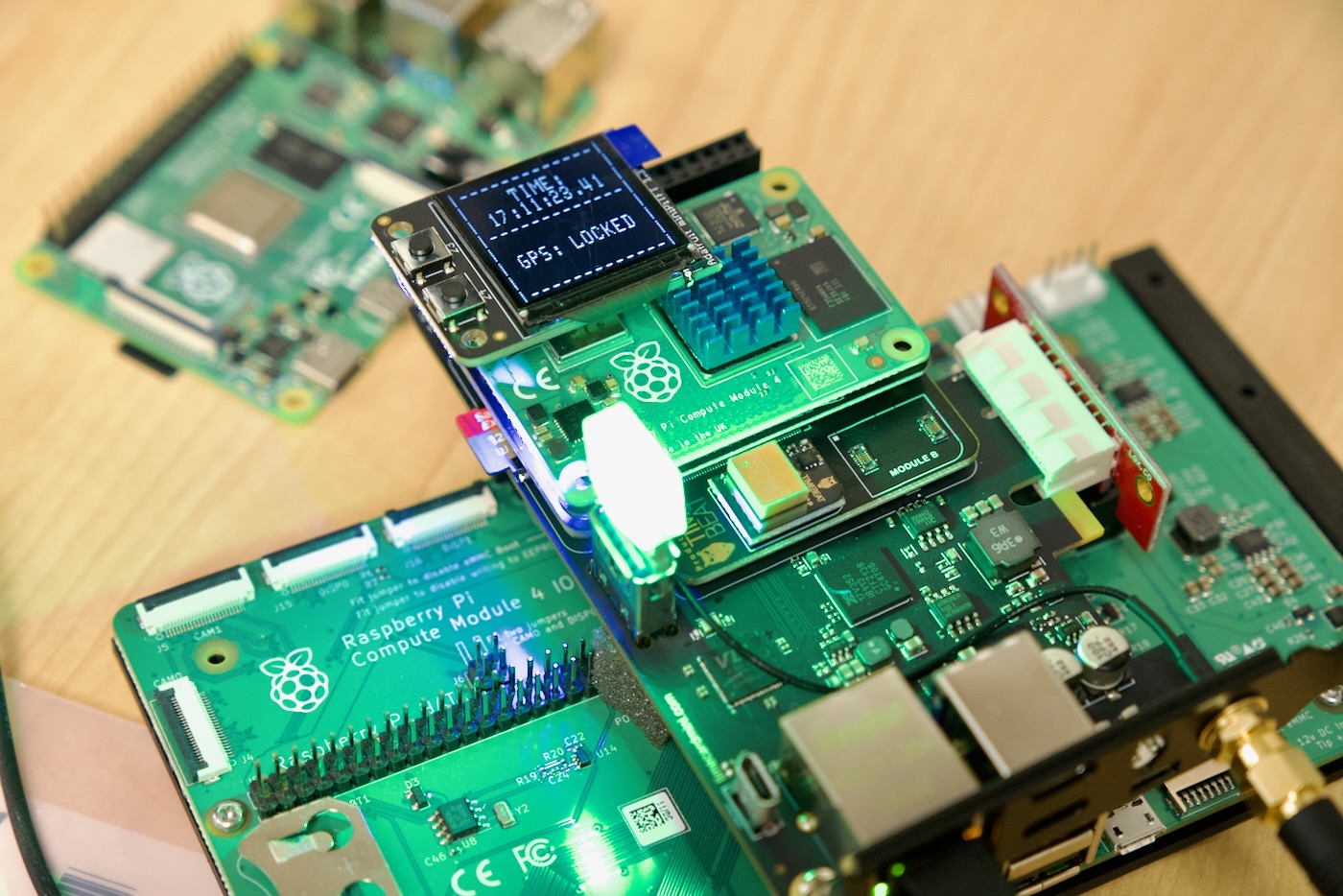
This build centers around the Time Card mini. Typically you'd install this PCI Express card inside another computer, but in my case, I just wanted to power the board in a semi-portable way, and so I plugged it into a CM4 IO Board.
The Time Card mini is a PCIe-based carrier board for the Raspberry Pi Compute Module 4, and by itself, it allows you to install a CM4 into a PC, and access the CM4's serial console via PCIe.
…Clearing up FUD surrounding Red Hat's actions
As someone who champions truth, yet knows truth is bent to espouse many ideas, I realize clever phrasing often turns irrational lies into strong beliefs—especially when passion takes over.
And we in the open source community are a passionate bunch.

But to clear the air a little bit—especially as I have seen some zingers going both directions (from Red Hat employees to the community, and vice-versa):
…