Father, author, developer, maker. Please consider sponsoring my work.
Setting up an Ubuntu Desktop installation for SSH, quickly
I've enjoyed using Ubuntu Server's GitHub SSH pubkey importer for a long time, it's a quick and easy way when doing an interactive server installation to get the built-in OpenSSH server configured for remote SSH access.
However, many computers I work on have Ubuntu Desktop installed instead, and it doesn't even include OpenSSH Server in the default packages!
So I thought I'd write up a quick guide for how to set up SSH on Ubuntu Desktop pulling in my GitHub SSH public keys quickly, since I haven't found a similar guide elsewhere:
…How I make thumbnails for YouTube
Over on the 2nd channel, I posted a video detailing my process for making thumbnails for my YouTube channel:
My videos target a more technical audience—and often deal with subjects crowds like those on HN might find interesting.
…How I monitor and control all my powered devices (Zigbee + HA)
Any time I show power consumption graphs for the SBCs, computers, and servers I test, I get a number of comments asking for more details about the setup.

It's quite simple, really: using my Home Assistant Yellow's built-in Zigbee radio, I connect a number of ThirdReality Zigbee Smart Outlets to it, and then I use ApexCharts Cards to add graphs of power consumption over time on my Home Assistant dashboards.
…Sipeed NanoCluster fits 7-node Pi cluster in 6cm

Sipeed's NanoCluster is a tiny compute module clusterboard with room for up to 7 tiny computers.
Each slot has two inline M.2 (NGFF) slots which accept either a custom-designed SoM (System on Module) or an adapter board to adapt a standard Compute Module form-factor board into the slot (as pictured above).
One end has a large fan for cooling, and the other end has power and IO. You can power the board via either PoE++ (60W) or through USB-C PD (65W). Or both, with redundant power fail-over.
…Self-hosting your own media considered harmful (updated)
I just received my second community guidelines violation for my video demonstrating the use of LibreELEC on a Raspberry Pi 5, for 4K video playback.
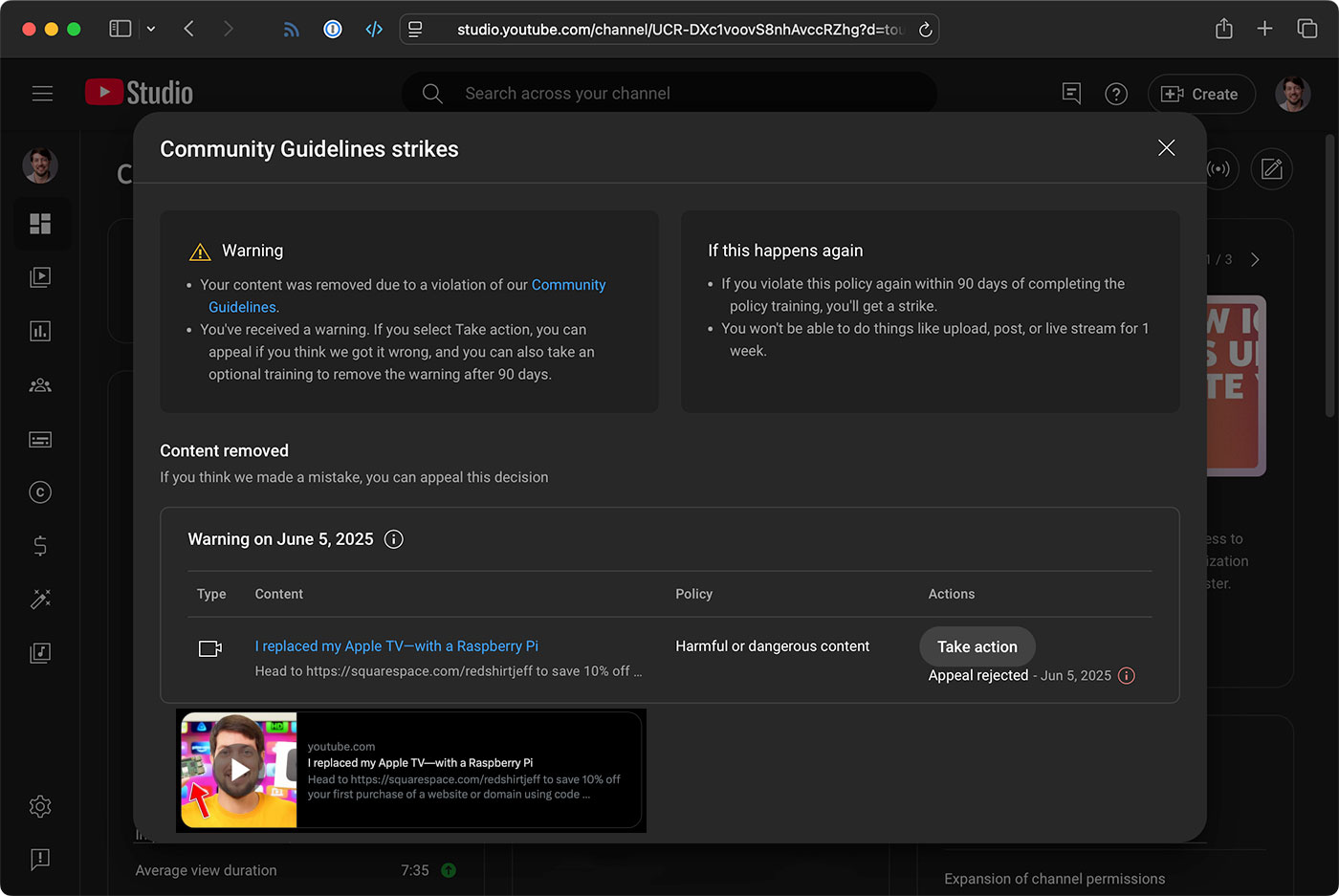
I purposefully avoid demonstrating any of the tools (with a suffix that rhymes with "car") that are popularly used to circumvent purchasing movie, TV, and other media content, or any tools that automatically slurp up YouTube content.
In fact, in my own house, for multiple decades, I've purchased physical media (CDs, DVDs, and more recently, Blu-Rays), and only have legally-acquired content on my NAS. Streaming services used to be a panacea but are now fragmented and mostly full of garbage—and lots of ads. We just wanted to be able to watch TV shows and movies without hassle (and I'm happy to pay for physical media that I want to watch).
…A limited-time flavor: Blue Raspberry Pi

The most unique Raspberry Pi I own is a limited-time flavor: blue raspberry. And no, this isn't the Brazilian version, or the red Chinese version. This blue version is one of 1000 blue Pis that were made to celebrate Raspberry Pi's first anniversary, 12 years ago.
What's crazy is this original Pi (well technically the 2nd revision of the original Pi...)? It's still supported. Apple usually stops supporting their Macs after 5-7 years. And Microsoft, well, it's complicated, but generally you're gonna get 8 to 10 years, if you're lucky and picked the right hardware.
…