Experience with getting LASIK a second time (2016 Edition)
In 2010, I had LASIK eye surgery on both eyes and had my vision corrected to 20/16. It seems my eyes weren't content, as they elongated slightly in the following years, and my vision degraded back to about 20/60... meaning I had to buy a couple pairs of glasses from Zenni to bridge the gap until I decided whether I'd get LASIK again.
Apparently only a small percentage of those who get LASIK after their mid-20s have their vision degrade much further... but being a Crohn's patient with moderate to severe symptoms I'm used to being in the 'unlucky' percentile! So I decided to go in for a second round of LASIK.

Despite the smile, I was getting quite tired of these spectacles!
I was going to get it done a few months ago, but then I had to get a Crohn's-related major surgery... then another minor operation... then my wife and I had our third baby... and finally I had a little time during my paternity leave to schedule the LASIK operation.
This time around, since I knew a lot of what I should expect, it wasn't quite as nerve-wracking an experience as before (see earlier post, Experience with LASIK). But it was still an extraordinary experience, and this time around I thought I'd jot down more detailed notes for the benefit of someone else considering the operation.
The preparation
Before you get LASIK, you have to go through a series of eye tests to make sure your eyes have enough corneal thickness for the operation, and to get a precise prescription and mapping of the surface of your eye. The tests involve a few different kinds of eye drops (I think ophthalmologists are addicted to eyedrops)—to numb your eye for a pressure test, to dilate your eyes for who-knows-what, and to dye your eye for a test that makes white things look yellow.
I'm not sure who invented all the weird eyeball-measuring devices that are used for these tests, but I know they all colluded with some fancy desk manufacturer, because every device had it's own special custom-built desk that looks like it was the price of my car.
After all these tests, you'll hopefully get the all-clear for the procedure (most people do, I think), and then you'll get to sign some extraordinarily scary-sounding papers, releasing the surgery center from liability for blindness, haloed vision, starry vision, blurred vision, partial blindness, and who knows what else. You can never say they didn't warn you of any potential outcome!
Pre-op preparation (a.k.a. "Valium time")
This being my second time getting LASIK, I was really quite relaxed; I remembered some of the most nerve-wracking moments, and also knew that if they screwed up one eye, I'd still have the other. Hopefully.
One of the technicians took me to a weird eye measuring device to recalculate diffraction, then had me read the eye chart a couple more times to confirm the prescription. Then, she dropped a set of numbing drops in my eyes, and gave me a couple Valium pills.
After the Valium, I was trotted over to a relaxation room. Otherwise known as the 'catalog of zen-like instruments' room, where there are some asian paintings, some bamboo in a vase, a small waterfall, and dim lighting. It's actually quite nice to take a 20 minute break from everything, though there were some random magazines in case I wanted to stimulate my brain cells a little more.
Halfway through, a cell-mate joined, and I promptly asked him, "So, is this your first time getting LASIK?".
Important note: Don't ever ask someone, minutes before a life-changing and potentially-blinding operation they think they'll only need once in their life, if this is their first time getting it done.
After digging myself out of that initial blunder, the technician came and led me to a patient room. The doctor then inspected my corneal flaps, then (since I had already gotten the flaps from my earlier LASIK procedure, therefore didn't need them cut again) used a tiny pointy thing (kind of like a steel toothpick) to cut them open again.
The flap-opening is by far the most stressful moment of LASIK, and of all the things this go-round, that was what made me the most nervous. That moment when your vision goes from 'whatever it is' to 'oh-my-gosh-I-am-legally-blind' blurry is the moment when you realize there's no going back!
The doctor flipped the flaps back shut again and told me to blink. ARE YOU SERIOUS? I cautiously blinked, hoping that the blink wouldn't just send my now-reopened cornea flap flying out of my eye, like a soft contact lens that didn't seat properly.
Luckily, the flap didn't fly, so it was down the hall to...
The laser
The first time around, I have vivid memories of the actual LASIK procedure, with the 'wavefront technology' laser. It's an impressively-sized machine inside a room that seemed to me to be under slight positive pressure (I guess to limit dust?). There's a bed that swivels around a little so you can lay in it and swing under the laser.
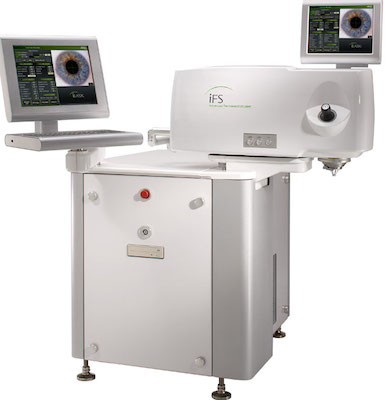
The magic LASIK machine. It's a pretty big device to create such a tiny, but precise, laser!
The technician walked me around the machine, in my Valium-induced stupor, and helped me lay flat on the bed. Then she handed me two little stress balls that were painted like eyeballs, and for some reason (probably the Valium), I thought that was the most clever thing. I probably said something stupid that I thought was funny at the time, but Valium does a good job of making you forget material better left for /r/dadjokes.
Aside: I found the eyeball stress balls on Amazon! Might have to pick one up now.
I remember the laser being imposing the first time I had LASIK, but this time I didn't pay much attention to it. After the doctor positioned my head just-so using a few strangely-molded pillows, then dripped another five or ten drops in my eyes, he told me he'd shift me under the laser, and to look at the orange light.
From this moment forward, focusing on the orange light becomes your number one priority in life. Breathing, listening, smelling, and everything else takes second place. For a second, as the doctor places weird metal eye-holder-opener things on your eyes, you think "Ah, this sharp little orange light—this is easy to focus on!" But then the doctor lifts the flap, and the sharp little light turns into a giant blur (along with the rest of your vision, but you're only focused on the orange light for now)!
Then you hear a nurse say something like "15 seconds", and you have only a moment to wonder if you're looking at the right place, or if you'll ever see again... because in the middle of this blurry game of 'try to focus on the center of the highly-blurry orange light', you start hearing a small fan spinning up (sounds like a handheld vacuum), then you hear a series of ZAP sounds.
The next 15 seconds of ZAP ZAP ZAP ZAP ZAP feels like an eternity, as your brain constantly ponders whether you're looking at the orange light correctly. And if not, and you move your eye just so to focus back on the center of the indistinct orange blur, will the 'advanced wavefront' technology be able to track the eye movement, or will it just burn a hole right through your eyeball into your brain stem, causing paralysis? Then you realize you're squeezing the two eyeball-painted stress balls so hard your fingernails are almost cutting your palms, and you try to relax.
Meanwhile, your sense of smell—to this point overridden by the singular concentration on the orange light—reminds you of its existence with a smell that can be only one thing: burning human flesh. If you've ever burnt skin on a soldering iron, you'll know exactly the smell. It's a strange and unforgettable smell, and the knowledge that the smell is coming from your friggin eyeballs makes you squeeze the stress-eyeballs even tighter.
Eventually, the ZAP is over, and your grip on the squishy eyeballs relaxes a little.
The doctor squirts some sort of solution all over your eye, lowers the flap (ah, vision again... so I'm not blind anymore... relief), and then acts like Picasso smoothing out the flap with a little brush so it sits correctly. Life is good. I think I can even see the ceiling clearly. Maybe this operation was a success, and I won't be blind after all!
Then it's time for the other eye.
Same series of events for this eye, but the nurse announces only 12 second this time. Sweet relief, only 10 years in eye-flap-open relative time!

Afterwards, everything seems a little 'glowy' or 'haloey'.
After everything's finished, you realize you can see everything in the room quite clearly, just with a slight bloom filter applied (everything is slightly 'glowy', especially light sources and reflective surfaces). The nurse walks you out of the room (still in Valium-induced relaxation mode), gives you instructions that you'll soon forget (that's part of the reason you bring a friend to help you get home), and sends you on your way.

Post-op (a.k.a "Dry eyes")
Depending on how you react to Valium (or whatever other drug the doctor used to get you relaxed), the next few hours may vary between 'my eyes hurt and I'm alert, but it's annoying seeing the world through thick plastic covers' and 'ahh, sweet sleep'. I'm in the latter group, so I can't say how my eyes felt right after the surgery, because right after getting home, I hopped (well, more dragged) into bed and fell asleep for a few hours.
But not before my wife could snap a picture of my excitedness:
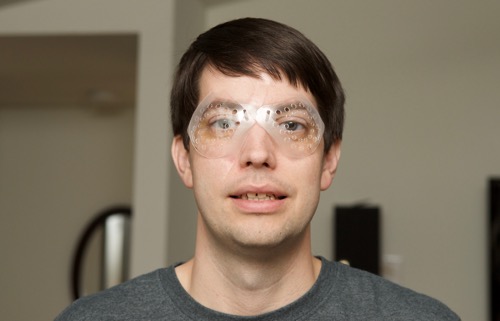
The weird plastic covers you wear for a day and four nights; note also the Valium-induced expressionless face.
The plastic covers make sleep a little annoying if you're a side-sleeper, since you have to kind of hold your head in a weird position, but it's better that than accidentally rubbing your eyes and displacing your corneal flap!
Once I woke up, I did have a slight amount of pain in my eyes (it's a weird feeling... kind of like if you got hit in the face by a water balloon?), so I took a couple Tylenol and started putting in the first of hundreds of eye drops. I use Refresh Plus drops, which were recommended by my doctor, and are nice in that I can tear off a little container to stick almost anywhere around the house, in my pocket, etc.
For the first few days, my eyes felt fairly dry, and since I also had a protective non-prescription soft contact lens covering both eyes, I had some scratchiness. I also had to drop one drop each of two prescription eyedrops, three times a day (and more frequently on the first day), to make sure the corneal flap didn't get infected and to help the healing process.
The first week, haloing and starriness around lights was highly annoying at first, then mildly annoying. Now a full week later, it's still noticeable but it doesn't really bother me as long as I keep putting in eyedrops every hour or so, and giving my eyes a break by closing them or focusing on something in the distance for a few minutes.
Conclusion
One day after this second LASIK procedure, I drove myself to the doctor's office (wearing my old trusty sunglasses with no prescription, yay!), and glanced at the wall chart. I couldn't believe my eyes, because this time:
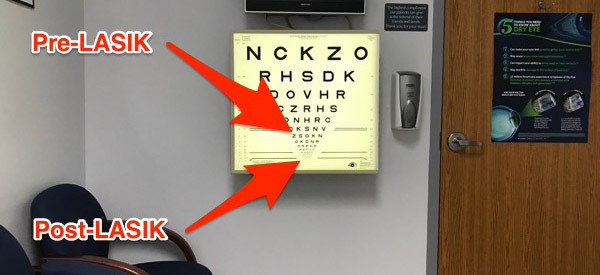
I could read the bottom line on the eye chart, without even squinting! Before the operation, when the technician would do the "is 1 or 2 better? now 2 or 3?" quiz, there was no level where I could see that bottom line. Apparently the LASIK correction was just right for my eyes, since I can clearly see that bottom line (and might be able to go one lower!), and it was even better than last time (when I was 20/16 afterwards).
It's now a week post-op, my vision continues to stabilize, and the doctor gave me an official vision acuity of 20/16 again, yay!
If you're financially able to get LASIK, and you have trouble with glasses or contacts, its definitely worth investigating. I spent a few weeks researching local doctors who performed the procedure for my initial operation, and after vetting TLC, Clarkson Eyecare, and Pepose Vision, I chose the latter, as I felt most comfortable with their staff, building, equipment, and Dr. Pepose.
I hope my story is helpful in your own LASIK consideration—or if you've already had LASIK, I hope it brings back some fun, scary, or interesting memories!
Comments